
Knowledge Base
Electronic Lab Notebook (ELN) overview
Electronic Lab Notebooks (ELN): Foundations, Architecture, and Integration
An Electronic Lab Notebook (ELN) within a Laboratory Information Management System (LIMS) is usually tightly structured so experimental work is standardised, traceable, and compliant. With a well-designed architecture, strong core components, and seamless integration with systems like LIMS and ERP, an ELN enhances data quality, accelerates research, and ensures compliance.
What Is an Electronic Lab Notebook (ELN)?
An Electronic Lab Notebook (ELN) is a digital platform designed to record, manage, and organise laboratory data and experimental workflows. It replaces or complements traditional paper lab notebooks by enabling scientists and researchers to document experiments, observations, protocols, and results in a secure, searchable, and shareable electronic format.
ELNs are widely used across academic research, biotechnology, pharmaceuticals, chemistry, materials science, and clinical research. Their primary goal is to improve data integrity, reproducibility, collaboration, and regulatory compliance while accelerating scientific discovery.
Evolution of ELN
The evolution of ELNs reflects broader advances in computing, data management, and scientific collaboration:
1. Paper-Based Era
Laboratory documentation relied entirely on handwritten notebooks. While legally accepted, these were difficult to search, share, audit, or back up.
2. Early Digital Notebooks (1990s–2000s)
Early ELNs focused on basic text entry and file storage, often as desktop applications. Adoption was limited due to poor usability and lack of integration with lab instruments.
3.Web-Based and Commercial ELNs (2000s–2010s)
Browser-based systems enabled collaboration, version control, and centralised storage. Vendors began offering discipline-specific ELNs (e.g., chemistry-focused ELNs).
4. Modern Cloud-Native ELNs (2010s–Present)
Today’s ELNs are cloud-based, API-driven platforms with strong security, regulatory compliance (e.g., FDA 21 CFR Part 11), and seamless integration with other laboratory systems such as LIMS, SDMS, and data analytics tools.
ELN and LIMS Connection
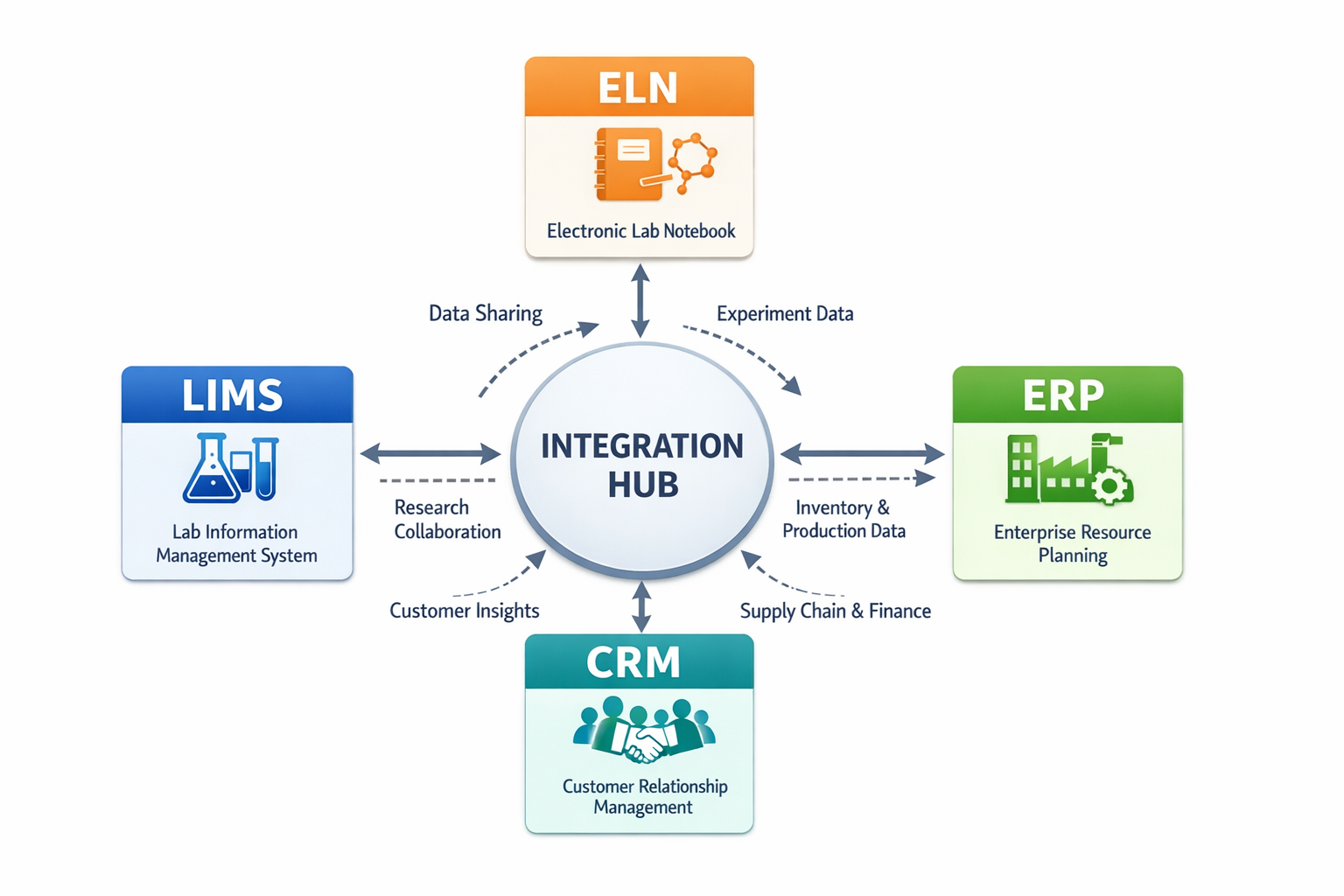
An ELN rarely operates in isolation. One of its most important integrations is with a Laboratory Information Management System (LIMS).
How ELN and LIMS Complement Each Other
-
ELN focuses on scientific context: hypotheses, experimental design, observations, and interpretations.
-
LIMS focuses on operational control: sample tracking, test scheduling, results reporting, and compliance.
Common Integration Scenarios
-
Sample Synchronisation
Samples created in LIMS are referenced directly in ELN experiments. -
Result Exchange
Analytical results generated and validated in LIMS are automatically linked to ELN experiment records. -
Workflow Continuity
Experimental planning in ELN triggers downstream testing workflows in LIMS.
A tight ELN–LIMS integration creates a unified digital lab ecosystem, reducing manual data entry and minimising errors.
ELN Architectural Overview
A well-designed ELN architecture balances usability, scalability, security, and interoperability. Most modern ELNs follow a modular, layered architecture.
High-Level Architectural Layers
1. Presentation Layer
The presentation layer is the user-facing part of the ELN and is responsible for how scientists interact with the system. It includes web-based and mobile interfaces that allow users to create, view, and edit experiments. Features such as experiment editors, dashboards, data visualizations, and reporting views are designed to be intuitive and efficient, ensuring that researchers can document their work with minimal friction while maintaining consistency and usability.
2. Application Layer
The application layer contains the core business logic that drives the ELN’s functionality. This layer manages experiment workflows, enforces rules and validations, and supports features such as protocol templates, version control, and collaboration. It is where automation logic resides, enabling tasks like experiment approval workflows, notifications, and structured data capture to improve efficiency and standardization across the laboratory.
3. Data Layer
The data layer is responsible for storing and managing all laboratory information. It handles structured data such as experiment metadata, results, and annotations, as well as unstructured data including images, documents, raw instrument files, and attachments. This layer ensures data integrity, traceability, and long-term retention while supporting efficient querying, retrieval, and backup of scientific records.
4. Integration Layer
The integration layer enables the ELN to communicate with other systems in the laboratory ecosystem. Through APIs and connectors, it integrates with tools such as LIMS, laboratory instruments, authentication services, and data analytics platforms. This layer supports data exchange, synchronisation, and event-driven workflows, reducing manual data entry and ensuring consistency across connected systems.
5. Security and Compliance Layer
The security and compliance layer underpins the entire ELN architecture by protecting sensitive scientific data and ensuring regulatory adherence. It manages user authentication and authorization, enforces role-based access control, and maintains detailed audit trails of all actions and changes. Features such as electronic signatures, time stamps, and data integrity controls are critical for meeting regulatory requirements and safeguarding intellectual property.
How an ELN Is Organised
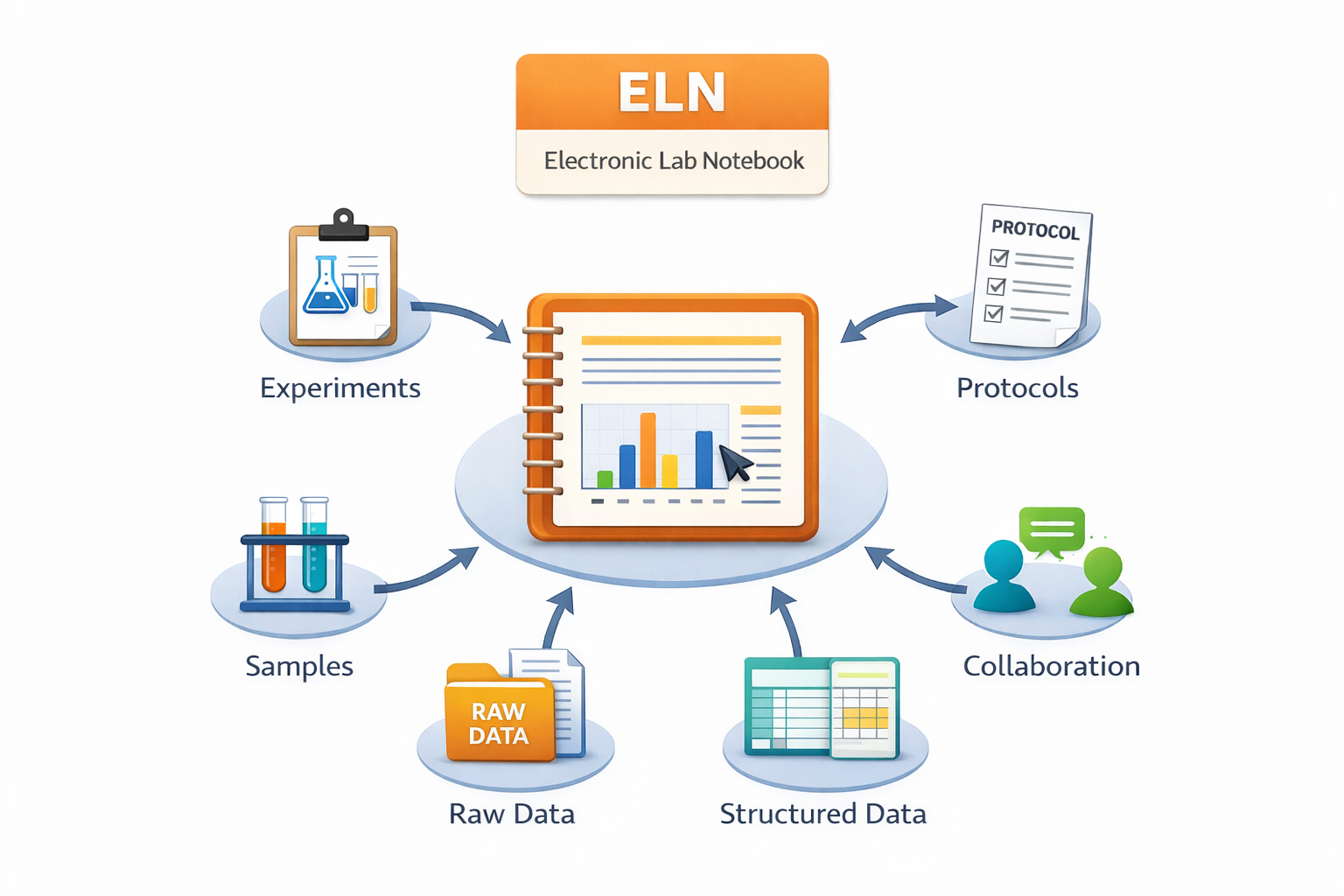
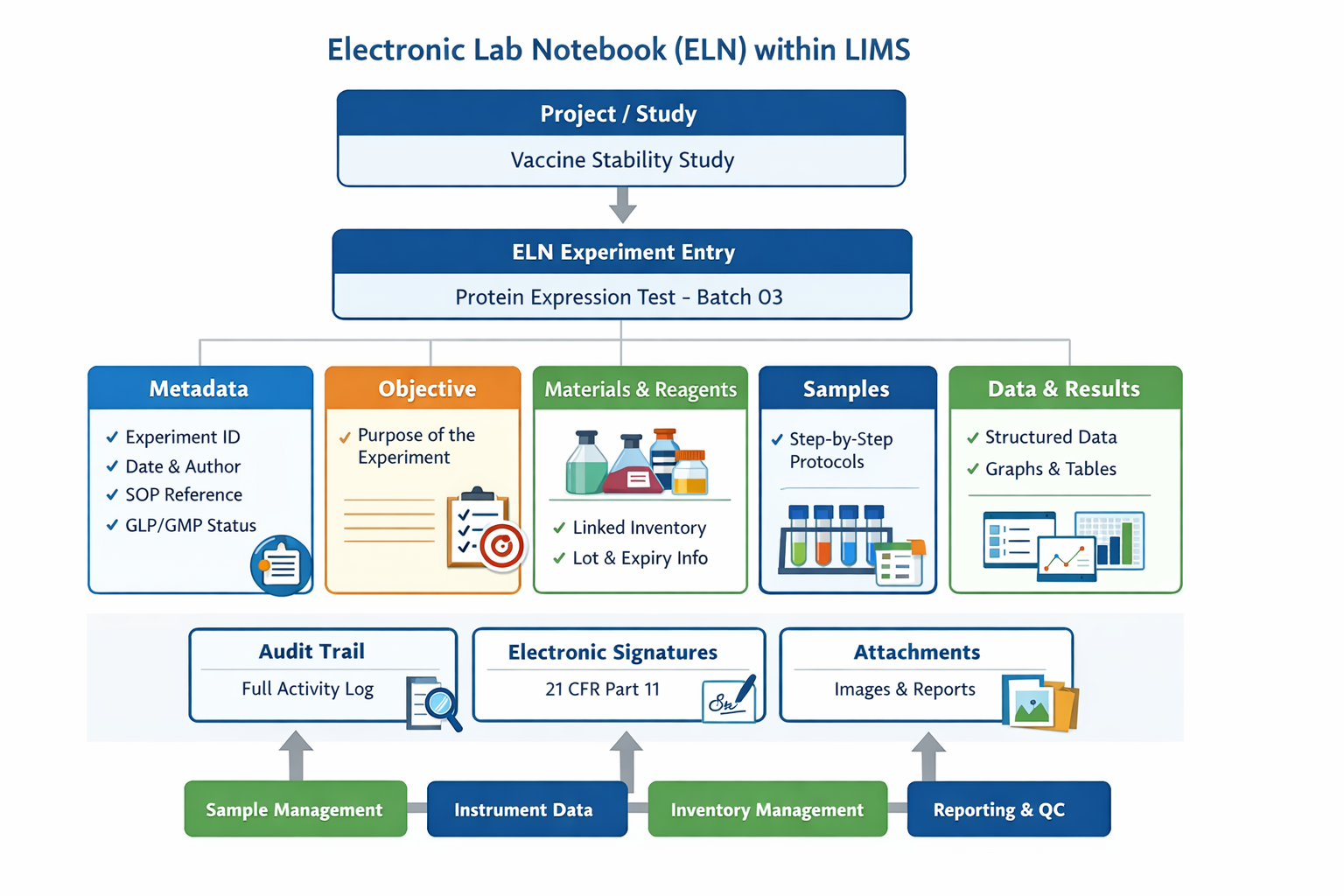
An ELN is typically organised around experiments as the central object, with all related information linked and traceable. The structure mirrors how scientists work in practice.
1. Central Notebook / Workspace
The core of the ELN is the digital notebook, where users:
-
Create and document experiments
-
Enter observations and results
-
Link data, samples, and protocols
-
Apply electronic signatures and approvals
Each entry is time-stamped, version-controlled, and auditable.
2. Hierarchical Organisation
Most ELNs follow a logical hierarchy such as:
-
Project
-
Study or Experiment
-
Experimental steps
-
Data and results
-
Conclusions and sign-off
-
-
This allows experiments to be grouped by project, product, customer, or study.
Key ELN Modules
1. Experiments
The experiment module is the heart of the ELN.
-
Records objectives, methods, results, and conclusions
-
Supports templates for standardized workflows
-
Enables step-by-step execution and documentation
-
Links all related data and samples
2. Protocols & Methods
This module stores standard operating procedures (SOPs) and experimental methods.
-
Reusable and version-controlled protocols
-
Ensures consistency and reproducibility
-
Can be directly referenced or instantiated in experiments
3. Data Management
ELNs typically manage two main data types:
-
Unstructured (Raw) Data
-
Instrument files, images, spectra, chromatograms, PDFs
-
Uploaded or automatically captured from instruments
-
-
Structured Data
-
Tables, calculations, metadata, and results
-
Enables analysis, comparison, and reporting
-
Both data types are linked directly to experiments for full traceability.
4. Samples & Materials
This module tracks:
-
Samples, reagents, and materials
-
Sample IDs, locations, and status
-
Links between samples and experiments
It often integrates with LIMS for advanced sample lifecycle management.
5. Collaboration & Knowledge Sharing
ELNs are designed for teamwork:
-
Shared experiments and projects
-
Comments and annotations
-
Role-based access and permissions
-
Cross-team visibility while protecting sensitive data
6. Compliance, Audit & Security
For regulated environments, ELNs include:
-
Audit trails (who did what and when)
-
Electronic signatures and approvals
-
Version control and change history
-
Secure access and data integrity controls
7. Search and Retrieval
- Advanced search using keywords, metadata, tags, and timestamps
8. Integration APIs
- REST /GraphQL or smilar APIs to connect with LIMS, instruments, and analytics platforms.
Benefits of Having a Well-Designed ELN
Investing in a well-architected ELN delivers significant scientific and operational value:
1. Improved Data Integrity and Reproducibility
Standardized templates and enforced metadata reduce ambiguity and experimental errors.
2. Enhanced Collaboration
Teams can share experiments, review results, and build on prior work across locations and time zones.
3. Operational Efficiency
Automation of routine documentation tasks allows scientists to focus on research rather than paperwork.
4. Regulatory and IP Protection
Secure audit trails and electronic signatures support regulatory compliance and intellectual property claims.
5. Knowledge Retention
Institutional knowledge is preserved even when researchers leave or projects end.
Why SynthVaults?
Unlike many standalone electronic lab notebooks that focus solely on experiment documentation, SynthVaults ELN is part of a unified, integrated platform that combines ELN, LIMS, CRM, and business process subsystems into a single enterprise solution. This level of integration eliminates data silos and significantly improves workflow continuity across scientific and operational teams, giving organizations centralised visibility over both their research and business processes.
One of the biggest differentiators is the tight integration between laboratory workflows and broader business systems. While traditional ELNs often require separate systems or custom integration work for inventory, sample tracking, or customer data, SynthVaults provides these capabilities natively within the same ecosystem. This leads to seamless data flows, reduced duplication of effort, and a more cohesive digital laboratory environment that bridges scientific research with operational decision making.
From a usability standpoint, SynthVaults is designed to cater to diverse laboratory workflows from early research to regulated development and quality control. By offering configurable templates, real-time collaboration tools, and structured data capture across experiment types and departments, it facilitates both standardisation and flexibility. These features help labs enforce consistent practices without sacrificing adaptability to unique protocols or project needs, something that many siloed ELNs struggle with.
The unified platform approach enhances compliance and governance. Because data, audit trails, sample records, and business activities are all recorded within a single architecture, laboratories can more easily demonstrate regulatory compliance, maintain traceability, and enforce quality standards across the entire lifecycle of research and operations. This end-to-end visibility is a powerful advantage over traditional ELNs, which typically require additional systems or manual processes to achieve the same level of oversight.